Pricing guide · read 7 Oct 2026
Mailgun pricing: $15 at 10,000 emails, $35 at 50,000 and $90 at 100,000
Mailgun's pricing page lists four plans for its Send product: Free at $0 with 100 emails a day, Basic at $15 for 10,000 emails a month, Foundation at $35 for 50,000, and Scale at $90 for 100,000. Foundation and Scale are labelled free for one month, then billed. Past 100,000 the slider read $215 at 250,000 emails and $400 at 500,000. Overage and validation fees apply on top, and log retention grows with the plan.
| Plan | Price | Emails included | Log retention | Sending domains | Extra emails |
|---|---|---|---|---|---|
| Free | $0 | 100 per day | 1 day | 1 | No monthly overage shown |
| Basic | From $15 per month | 10,000 per month, no daily limit | 1 day | 1 | From $1.80 per 1,000 |
| Foundation | $35 per month after a free first month | 50,000 per month | 5 days | 1,000 | From $1.30 per 1,000 |
| Scale | $90 per month after a free first month | 100,000 per month | 30 days | 1,000 | From $1.10 per 1,000 |
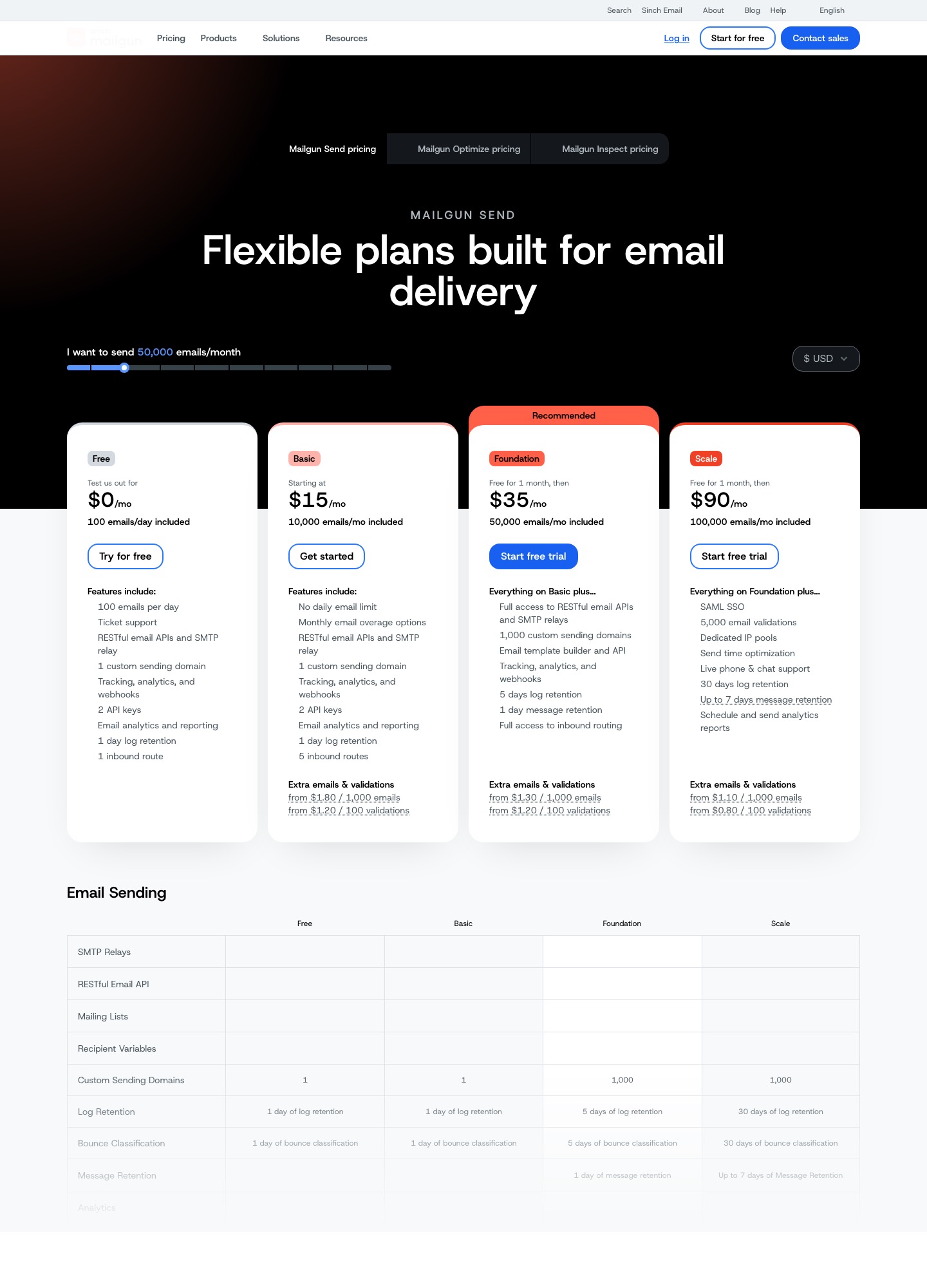
What each volume costs, and why 100,000 has two prices
Mailgun's slider moves in steps, and the screenshot above shows it parked at 50,000 emails a month. The readouts below are the stops I took on 7 October 2026. The last column is the price divided by thousands of emails, which I worked out myself; Mailgun does not publish it.
| Emails per month | Plan shown | Price per month | Per 1,000 emails |
|---|---|---|---|
| 10,000 | Basic | $15 | $1.50 |
| 50,000 | Foundation | $35 | $0.70 |
| 100,000 | Foundation | $75 | $0.75 |
| 100,000 | Scale | $90 | $0.90 |
| 250,000 | Scale | $215 | $0.86 |
| 500,000 | Scale | $400 | $0.80 |
Two things stand out. The cheapest point per email is Foundation at 50,000, not the biggest plan. And at 100,000 emails you can choose between Foundation at $75 and Scale at $90, a $15 difference. What that $15 buys is on the page's feature list: Scale adds SAML SSO, dedicated IP pools, send time optimization, live phone and chat support, 30 days of log retention instead of five, and up to 7 days of message retention instead of one. If none of those matter to you, Foundation at 100,000 is the lower bill. Mailgun's FAQ also says one dedicated IP is included with Foundation 100k, Growth and Scale plans, so the cheaper choice does not lose an IP.
The page's tooltips show how the extra-email rate falls as you climb: Scale reads $1.10 per 1,000 at 100k, $0.90 at 250k, $0.75 at 500k, $0.60 at 750k, $0.50 at 1M and $0.40 at 2.5M. I would not turn those into a bill for a volume that is not on the slider, because the tooltip does not say how a month between two stops is priced. Move the slider and read the price instead.
The Free plan and its daily cap
The Free plan sends 100 emails per day, not per month, and the page states no monthly meter. It includes ticket support, the REST API and SMTP relay, one custom sending domain, two API keys, tracking and webhooks, one day of log retention and one inbound route. Mailgun's FAQ adds that Free accounts are limited to one user. A newsletter to 500 people cannot go out in one day on this plan, so Free suits wiring up an integration or a low-volume notification, not a campaign. Basic removes the daily limit and raises the inbound route count to five, but keeps one sending domain and one day of logs. Foundation is where the page lists 1,000 custom sending domains and an email template builder with an API.
Billing details that change the real cost
According to the FAQ, signing up bills only the prorated amount of the selected plan for the current month. After that, the monthly plan price and any extra emails and validations are billed at the start of each month for the previous month. So an overage month shows up on the next invoice, not the day you pass your quota. The same FAQ says paid plans offer free 30-day trials that unlock higher-tier features such as phone support, longer log retention and SAML SSO.
Email validation is its own meter. Basic and Foundation list validations from $1.20 per 100 for the first 5,000, then $0.80 for the next 45,000 and $0.50 for the next 50,000. Scale includes 5,000 validations and lists its extra rate from $0.80 per 100. That matters if you check address lists before sending: a 20,000-address list on Basic would cost $60 for the first 5,000 plus 15,000 at $0.80 per 100 for $120, which is $180 by the page's own tiers. Extra dedicated IPs are $59 per IP per month, added from the control panel or through support.
Mailgun also lets you choose where your data lives. The pricing page says you can send email through the US or the EU from a single account, with the service hosted in both regions. The API host changes for EU domains: the sending docs say to replace api.mailgun.net with api.eu.mailgun.net, and templates are isolated by region, so you create them again in each one.
Sending AI-drafted copy through Mailgun's API
Suppose a marketer drafts a renewal reminder in Lavender, Jasper or a general chatbot, and a developer wants it delivered. Mailgun's HTTP sending page offers two ways in: submit the text, HTML and attachment parts yourself, or send a pre-built MIME message. It sets a 25MB maximum message size, and its curl examples post to /v3/YOUR_DOMAIN_NAME/messages. A gotcha the page flags: use --form-string for the html field, or the curl command may fail.
For anything repeated, the templates route is cleaner. The templates page says you store a template once, by API or in the Template Builder, and reference it by name or by ID when sending. It caps account-level templates at 100 per account and 40 versions per template, with the same limits per sending domain. Here is the page's send example:
curl -s --user 'api:YOUR_API_KEY' \
  https://api.mailgun.net/v3/YOUR_DOMAIN_NAME/messages \
  -F from='Excited User <postmaster@YOUR_DOMAIN_NAME>' \
  -F to=recipient@example.com \
  -F subject='Hello there!' \
  -F template="template.test" \
  -F t:variables='{"title": "API documentation", "body": "Sending messages with templates"}'
The sending page recommends t:variables over the older v: parameters, because the first hides the variables from the MIME and from event data. A workable pattern for assistant-written copy is to keep the approved wording in the template and pass only the changing parts as variables, so a pasted draft never has to be edited inside application code.
The batch sending page covers personalised sends to a list: put several addresses in the to field and supply recipient-variables, referenced in the body as %recipient.name%. It warns that without recipient variables every recipient sees everyone else's address in the To line, and it sets the batch maximum at 1,000 recipients. SMTP works too, on ports 25, 465, 587 and 2525, per the SMTP page, which recommends 587 because some ISPs block port 25. The sending page I read does not describe an idempotency key, so a retry after a timeout needs your own duplicate check.
On AI, Mailgun's pricing page has a section titled "Send smarter with AI-powered tools" whose text speaks of reaching each person at the right time, and it lists send time optimization on the Scale plan. The page names no feature that writes or rewrites email copy, so the drafting still happens in your assistant of choice.
Who should pick Mailgun, and who should not
Pick Mailgun if a developer owns delivery and wants a per-domain API with templates, inbound routes, webhooks and an EU region, and if you will likely sit between 50,000 and 100,000 emails, where Foundation reads $35 to $75. It is also sensible when several brands send from separate domains, since Foundation lists 1,000 of them.
Skip it if you want a free plan with a monthly allowance rather than a daily one; Resend lists 3,000 a month on Free, with its own 100-a-day cap. Teams that send under 10,000 emails a month and care mostly about stream separation should compare Postmark, and those who need subusers and a bundled campaign tool should read the SendGrid guide. For a flat-fee relay at 10,000 emails, SMTP2GO is another comparison, and our method page explains how these readings were taken.
FAQ
Does Mailgun have a free plan?
Yes. The pricing page lists Free at $0 with 100 emails per day, one custom sending domain, two API keys and one day of log retention. It is capped by day, so it is meant for testing an integration rather than running a mailing.
Why is Mailgun cheaper at 100,000 emails on Foundation than on Scale?
The slider read $75 for Foundation and $90 for Scale at 100,000 emails on 7 October 2026. Scale adds SAML SSO, dedicated IP pools, send time optimization, phone and chat support and longer log retention. Choose Foundation if you do not need those.
Can I send a template with variables through the API?
Yes. The templates page shows a message posted with a template name and a t:variables JSON value. For personalised batches, the batch page uses recipient-variables, up to 1,000 recipients per message.
Does Mailgun write email copy with AI?
Its pricing page mentions AI-powered tools and lists send time optimization, but it names no copy-writing feature. Draft in an assistant such as Lavender or a chatbot, then load the approved text into a template.