Pricing guide · read 7 Oct 2026
Postmark pricing: $15 for the first 10,000 emails, $55 at 50,000
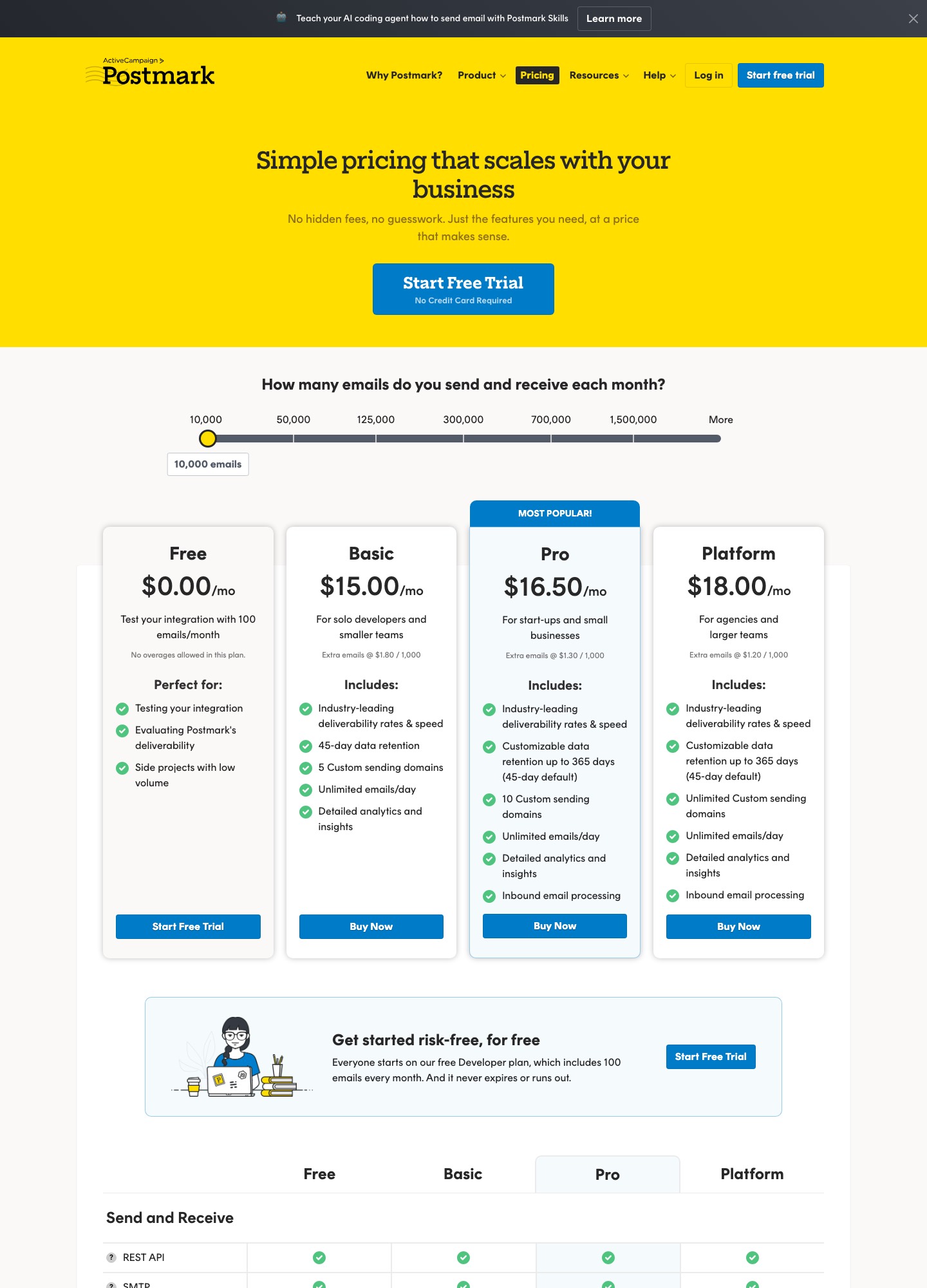
Postmark's pricing page lists Free at $0 for 100 emails a month with no overages, then Basic at $15, Pro at $16.50 and Platform at $18, each starting at 10,000 emails a month. Its volume slider moves all three: Basic reads $55 at 50,000 emails, $115 at 125,000 and $245 at 300,000. The page lists no plan between 100 and 10,000 emails a month, so a small team pays the $15 floor.
| Emails per month | Basic | Pro | Platform | Platform minus Basic |
|---|---|---|---|---|
| 10,000 | $15.00 | $16.50 | $18.00 | $3.00 |
| 50,000 | $55.00 | $60.50 | $66.00 | $11.00 |
| 125,000 | $115.00 | $126.50 | $138.00 | $23.00 |
| 300,000 | $245.00 | $269.50 | $294.00 | $49.00 |
The plans differ by features, and the gap widens with volume
On Postmark's page the three paid plans do not differ in how many emails they send. Each includes unlimited emails a day and the same deliverability pitch. What changes is the feature set and the overage rate shown with the slider at 10,000: $1.80 per 1,000 extra emails on Basic, $1.30 on Pro, $1.20 on Platform. Basic lists 45-day data retention and five custom sending domains. Pro adds retention you can customise up to 365 days, ten sending domains and inbound email processing. Platform lists unlimited sending domains plus the same retention and inbound features.
At all four stops Pro reads exactly 10 percent above Basic and Platform exactly 20 percent above, so the premium for the higher plans grows with your volume. Platform costs $3 more than Basic at 10,000 emails and $49 more at 300,000. Whether that is worth paying turns on whether you need Pro's inbound parsing and longer retention, or Platform's unlimited domains. Inbound parsing, the page explains elsewhere, turns an incoming email into a JSON object posted to your webhook URL.
Moving up the slider versus paying for extra emails
The slider readouts allow one comparison that the page does not make for you. On Basic, going from the 10,000 stop to the 50,000 stop adds $40 for 40,000 more emails, which is $1.00 per extra thousand. That is below the $1.80 per thousand overage shown at 10,000. On Pro the same move adds $44, or $1.10 per thousand against a $1.30 overage. On Platform it adds $48, or $1.20 per thousand, the same as that plan's overage rate. So a sender who keeps overshooting 10,000 emails will usually pay less by moving the slider than by living on overage, and a Platform customer is indifferent. The FAQ says extra emails are calculated at the end of the billing cycle and added to the following month's plan cost, and that unused emails do not roll over.
I stay with those readouts and do not price a month at, say, 30,000, because the page does not publish a stop there and I would be inventing a number.
What the free plan really is
Free is described as a way to test your integration with 100 emails a month, and the card says no overages are allowed. The FAQ states it never expires. There is no tier between 100 and 10,000 emails a month, which the page says outright, so a product that sends 600 password resets and receipts a month has no cheaper step than $15. Two billing facts from the same FAQ are worth knowing: Postmark takes Visa, MasterCard, American Express, Diners and JCB, but not PayPal or purchase orders, and it does not offer annual plans yet. A bootstrapped company that has launched, charges customers and has taken no outside investment can contact support for a $75 account credit, according to the page.
Add-ons that change the bill
| Add-on | Starts at | Condition on the page |
|---|---|---|
| Dedicated IP | $50 per month per IP | Customers sending 300,000 emails a month or more; Pro plans or higher |
| Custom activity retention | $5 per month | Pro plans or higher; default is 45 days |
| DMARC monitoring | $14 per month per domain | None stated |
The dedicated IP rule is the one that surprises people. At the 300,000 stop, Pro reads $269.50 and Platform $294.00, so adding one IP at $50 brings those to $319.50 and $344.00, and a team below 300,000 emails cannot buy one at all. The page's FAQ adds only that dedicated IPs are available to high-volume senders.
Streams, templates and the API for AI-drafted copy
Suppose a team has Jasper or Copy.ai produce the wording for a trial-expiry note, and also a monthly product newsletter. Postmark's FAQ says marketing and transactional email should never mix, and explains that Message Streams give each its own separate sending infrastructure. In the API, the send guide says MessageStream defaults to the outbound stream, the default transactional one, if you do not name another. Put the newsletter on a broadcast stream, not the default.
The same guide lists constraints you can plan around. A message must come from a confirmed sender signature or the API answers 422. To, Cc and Bcc together cannot exceed 50 recipients. A subject can be 2,000 characters. Passing POSTMARK_API_TEST as the server token sends nothing real, which suits a first run with assistant-written text. The batch endpoint takes up to 500 messages and 50 MB per call, and it returns a 200-level status even when individual messages fail, so you must check each result. I found no idempotency key on those pages, so deduplicating retries is up to your code.
For repeated mail the guide recommends templates. Its TypeScript example, using the official postmark package, is:
const result = await postmark.sendEmailWithTemplate({
  From: "welcome@acme.example",
  To: "customer@example.com",
  TemplateAlias: "welcome",
  TemplateModel: { name: "Ada" },
  MessageStream: "outbound",
});
That call is quoted from the send guide, which sets up the client with a server token in an environment variable. The templates API page says a server may hold up to 100 templates, that you identify one by TemplateId or TemplateAlias, and that the TemplateModel generates the HTML body, text body and subject. It also says CSS in a style block is inlined by default unless you pass InlineCss as false. An assistant-drafted body fits as the template's HTML or text, with the person-specific parts as model fields.
What Postmark says about AI
The pricing page lists no feature that writes email copy. What it does carry is a banner reading "Teach your AI coding agent how to send email with Postmark Skills." The linked blog post describes Postmark Skills as open source Agent Skills, installable with npx skills add ActiveCampaign/postmark-skills, that give a coding agent instructions on sending, inbound email, webhooks and email best practices. The post also mentions an MCP server and an llms.txt file. These are aids for whoever writes your integration code with an agent, not tools that draft the message itself, so a copy assistant still sits outside Postmark.
Who should pick Postmark
Choose it if receipts, resets and alerts must arrive and you want them separated from promotional mail by design. The 45-day default retention and per-message activity make a complaint easy to trace, and Pro's inbound parsing suits reply-by-email flows.
Look elsewhere if cost per email is the main test. At 50,000 emails Basic reads $55. For the same volume Resend lists $20 on Pro. Mailgun lists Foundation at $35, though neither includes the same stream model. Senders who also want campaign tools should read the SendGrid guide or MailerSend, and the index lists the rest.
FAQ
How much does Postmark cost for 50,000 emails a month?
The slider read $55 on Basic, $60.50 on Pro and $66 on Platform at 50,000 emails on 7 October 2026. The three plans send the same volume; they differ in retention, domains, inbound processing and overage rates.
Is there a plan between the free tier and 10,000 emails?
No. The pricing page's FAQ says there is no tier between the free 100 emails a month and 10,000 emails a month, so Basic at $15 is the smallest paid step.
Can I buy a dedicated IP at low volume?
Not according to the page. Dedicated IPs start at $50 a month per IP, but only for customers sending 300,000 emails a month or more, and only on Pro or higher.
Does Postmark help with AI-written emails?
Its blog describes open source skills that teach coding agents to use the Postmark API correctly, and the pricing page lists no copy-writing feature. You can send assistant-drafted text through a template and a transactional or broadcast stream.